Redefining Aesthetic Medicine: From “Fighting Age” to Living Well With Time
Nextapple News | Reported by Zhang Chia-Ling
In an era where medical aesthetics is gradually moving beyond the impulse to “fight aging,” a more thoughtful philosophy is beginning to take shape—one that sees aging not as an enemy, but as a natural evolution to be supported with care. Dr. Po-Jen Hsueh, founder of Le Renouveau Clinic, is among the physicians leading this shift. His approach to facial rejuvenation is not driven by the pursuit of youth at all costs, but by the pursuit of balance, vitality, and dignity over time.
Central to Dr. Hsueh’s philosophy is the Japanese art of kintsugi—the craft of repairing broken pottery with gold. Rather than hiding damage, kintsugi honors it, transforming fractures into a luminous part of the object’s story. Dr. Hsueh draws from this idea in his work: aesthetic medicine, in his view, should be about restoration rather than concealment—enhancing harmony while preserving the individual’s character.
“At its core, beauty is not about erasing age,” he explains. “It’s about preventing aging from showing up as abrupt, unnatural change.” Aging, he believes, can be visible—and still deeply beautiful. At Le Renouveau, this belief has evolved into a signature treatment philosophy Dr. Hsueh calls Timeless Refinement: an integrated approach built on structural support, regenerative medicine, and holistic balance, designed for those who want to age naturally—but elegantly.

|A Kintsugi-Inspired Perspective: Restoring Rather Than Replacing
Facial aging, Dr. Hsueh notes, rarely occurs in a uniform pattern. For some, the earliest signs appear around the eyes; for others, it is the gradual loss of volume in the midface, chin, or jawline that alters the overall expression. While skincare can improve surface texture, aging often begins deeper—within the architecture of the face.
“Aging is inevitable,” he says. “But when most people talk about aging gracefully, what they truly mean is: ‘I want to look like myself—just less tired. Less heavy. Less suddenly aged.’ Usually, they hope to look five to ten years younger, not twenty.”
This is where kintsugi offers a compelling metaphor.
“Like repairing a ceramic bowl with gold,” Dr. Hsueh explains, “the goal is not to cover the cracks, nor to make the object ‘brand new.’ It is to restore integrity—then elevate its natural beauty.” In aesthetic practice, this translates into using modern medical tools to refine structure, improve vitality, and restore balance—so the face appears cohesive, healthy, and naturally refreshed, without chasing an artificial ideal.
|Three Principles Behind Le Renouveau’s Aesthetic Practice
At Le Renouveau Clinic, Dr. Hsueh insists that results should never come at the expense of identity. His method is grounded in precision—and guided by three core principles:
Clinical Judgment
Every plan is individualized. Rather than applying one-size-fits-all trends, treatments are guided by medical assessment, facial anatomy, and long-term aesthetic logic.Trusted Products and Technology
Le Renouveau uses only clinically validated injectables and evidence-backed devices—prioritizing safety, predictability, and long-term outcomes over novelty.Structural Harmony
The face is treated as an integrated system. Instead of chasing isolated improvements (such as lips or tear troughs alone), the focus is placed on restoring the underlying framework that supports overall balance.
This approach also explains why Dr. Hsueh does not favor excessive filling. In his view, the modern aesthetic challenge is not simply “adding volume,” but rebuilding structural support.
“Before you refine details, you need to restore the architecture,” he says. This may involve supporting key structural points—such as the nose base, brow contour, cheek foundation, and chin projection—before refining delicate areas like under-eyes or lips. The goal is not overt transformation, but subtle reinforcement, creating a face that looks lighter, calmer, and more naturally lifted.
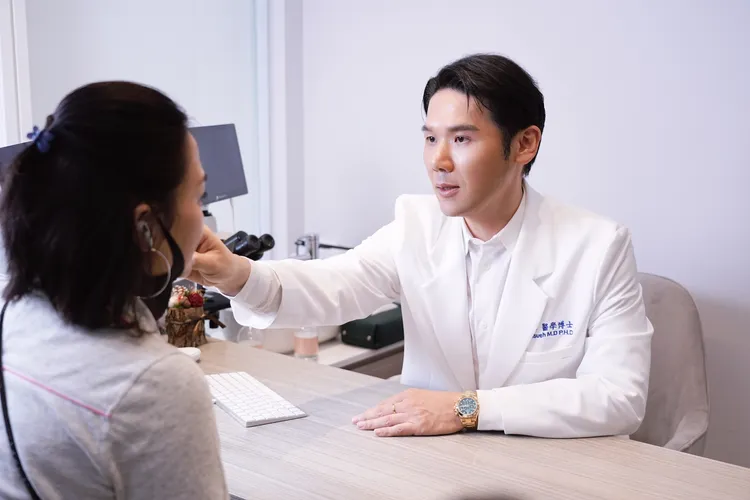
|Regeneration Meets Prevention: Inside the Timeless Refinement Protocol
Dr. Hsueh sees a growing gap in the market: many patients feel caught between basic non-invasive treatments (that may not hold) and surgical procedures (that feel too drastic, too soon). Le Renouveau’s response is a protocol that combines regeneration and prevention, offering an advanced middle path.
“If you wait until aging becomes severe,” he says, “then surgery may be the only option—and that comes with downtime and psychological pressure. Instead, we encourage early maintenance that supports regeneration, reduces chronic inflammation, and slows structural decline.”
The Timeless Refinement program integrates regenerative strategies with advanced clinical techniques to strengthen skin density, elasticity, and facial support layers. Treatments often include collagen-stimulating injectables such as Sculptra and Profhilo, along with exclusive protocols like OxyGlow Therapy, designed to improve tissue vitality and restore healthy resilience.
“This kind of integrated approach tightens gradually,” Dr. Hsueh explains. “It reduces puffiness and sagging without creating an overfilled look. The result is not a face that looks done—but a face that looks well: firmer, more elastic, and more awake.”

|A Clinic Designed to Feel Like a Living Space
Looking ahead, Dr. Hsueh sees Le Renouveau Clinic as more than a destination for facial rejuvenation. He hopes to build it into a trusted platform for longevity and graceful aging across the Chinese-speaking world—integrating outward refinement with inner wellness, and redefining what it means to age beautifully.
Receiving the Apple Beauty Award Clinic of the Year is an affirmation of this vision.
“It’s a great honor,” he says. “But more than that, it reminds us why professionalism matters. Aesthetic medicine is built on trust—and trust is built over time. Our mission is to help every patient feel confident not by changing who they are, but by restoring what time has gently taken—and helping them meet their future with clarity.”


Photography credit: Peng Xin-Wei